Ancient Greece
A bronze computer, two thousand years old, that predicted eclipses
In 1901 sponge divers lifted a corroded lump of bronze from a shipwreck off the Greek island of Antikythera. Inside were gears, and on the gears, the sky.
The Plutto Magazine · 13 October 2026 · 2 min read

The ship went down around 70 to 60 BC with a cargo of statues and glass. The fragment sat in the National Museum in Athens for months before anyone noticed a gear wheel in it. It took most of the next century, and in the end X-ray tomography, to read what the rest of it was.
The sky, on a crank
The Antikythera mechanism was a box about the size of a shoebox, worked by a hand crank. At least thirty bronze gears survive. Turning the crank moved a pointer for the Sun and one for the Moon around a zodiac dial on the front, while a small ball, half silver and half dark, turned to show the Moon’s phase.
One pair of gears is mounted off-centre with a pin running in a slot, so the Moon’s pointer speeds up and slows down through the month, just as the real Moon does. It is a working model of a Greek theory of the Moon’s motion, cut in bronze.
Nothing of comparable complexity survives from the next thousand years.
Eclipses, by the calendar
On the back, a spiral dial counted 223 lunar months, the saros: after 223 months, the Sun, Earth and Moon line up in nearly the same way again, so eclipses repeat. Babylonian astronomers had found this cycle centuries earlier. Small glyphs on the dial marked the months that would bring an eclipse, and even the hour.
Another dial tracked the four-year cycle of the Panhellenic games, the Olympics among them. The device is a calendar, an almanac and a model of the cosmos at once, and nothing of comparable complexity survives from the next thousand years, until the astronomical clocks of medieval Europe.
In the app
What is coming
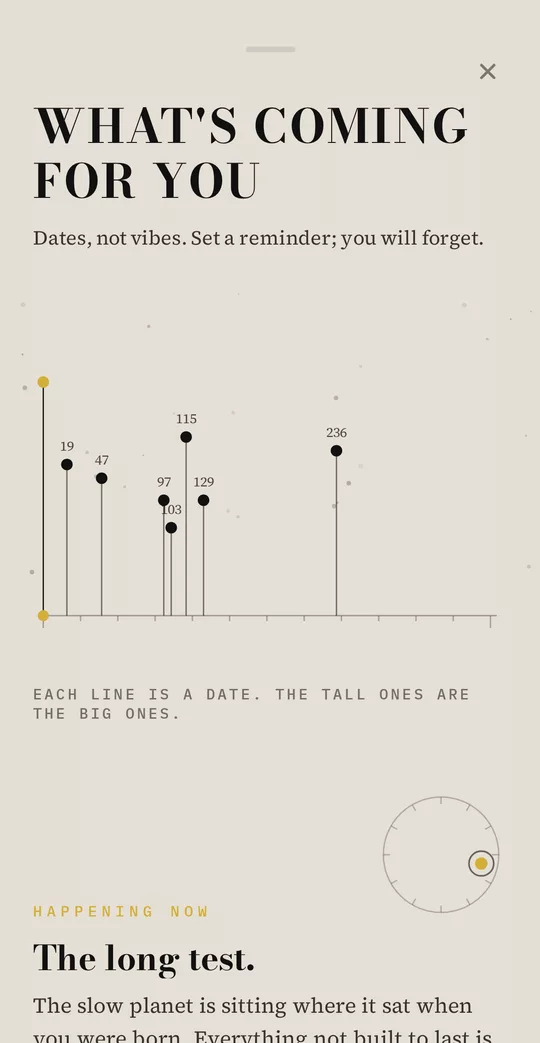
The next two years on one line, drawn from your own sky, with a reminder for each date.
Open PluttoSources
- T. Freeth et al., “Decoding the ancient Greek astronomical calculator known as the Antikythera Mechanism,” Nature 444 (2006).
- T. Freeth et al., “Calendars with Olympiad display and eclipse prediction on the Antikythera Mechanism,” Nature 454 (2008).
- T. Freeth et al., “A Model of the Cosmos in the ancient Greek Antikythera Mechanism,” Scientific Reports 11 (2021).
- Derek de Solla Price, Gears from the Greeks (1974).
Plutto presents these traditions for reflection; it does not claim that astrology predicts events.
Read next
The whole issue →
Astronomy
The astronomer who cast horoscopes
Johannes Kepler found the laws of planetary motion that still steer spacecraft. He also drew up birth charts for a living, including two for the most feared general in Europe.
2 min read
The week
Why Monday follows Sunday: your week is a planetary clock
The days of the week are named for the seven lights the ancient world saw wandering across the sky. But their order isn’t the planets’ order. It falls out of a clock that gave every hour of the day to a planet.
2 min read
The zodiac
The two zodiacs are 24° apart, and drifting further
The zodiac in a magazine horoscope and the one an Indian astrologer uses were once the same. The Earth’s slow wobble has pulled them apart, by about a day every seventy-two years.
2 min read