The week
Why Monday follows Sunday: your week is a planetary clock
The days of the week are named for the seven lights the ancient world saw wandering across the sky. But their order isn’t the planets’ order. It falls out of a clock that gave every hour of the day to a planet.
The Plutto Magazine · 13 October 2026 · 2 min read
Ancient astronomers counted seven bodies moving against the fixed stars: Saturn, Jupiter, Mars, the Sun, Venus, Mercury and the Moon. Listed like that, they run from the slowest to the fastest, the order Hellenistic astrologers used for everything.
A planet for every hour
Those astrologers gave each hour of the day a ruling planet, in that order, over and over. Give the first hour of a day to Saturn. Twenty-four hours later the cycle of seven has gone round three times with three hours to spare, so the first hour of the next day lands on the Sun. The day after that begins with the Moon, then Mars, then Mercury, Jupiter and Venus, and then Saturn again.
Each day was named for the planet that ruled its first hour.
Each day was named for the planet that ruled its first hour, and that is the week we still keep: Saturday, Sunday, Monday. The Roman historian Cassius Dio described this explanation around AD 200.
The same week in many languages
English swapped four of the gods for their Norse counterparts: Tiw for Mars (Tuesday), Woden for Mercury (Wednesday), Thor for Jupiter (Thursday), Frigg for Venus (Friday). Spanish kept the planets: martes, miércoles, jueves, viernes. In Hindi the week runs Ravivar, Somvar, Mangalvar, Budhvar, Guruvar, Shukravar, Shanivar: Sun, Moon, Mars, Mercury, Jupiter, Venus, Saturn, in exactly the same order. Japanese names the days for the Sun, the Moon, fire, water, wood, metal and earth, the elements East Asian astronomy gave to the same planets.
The hours, still counted
Planetary hours are still used for choosing a time to begin things. In Sanskrit an hour of this kind is a horā, borrowed from the Greek hōra, the word that also gave English “hour” and “horoscope.” Plutto works out the day’s hours, Rahu kalam among them, from the real sunrise and sunset where you are, not from a fixed six o’clock.
In the app
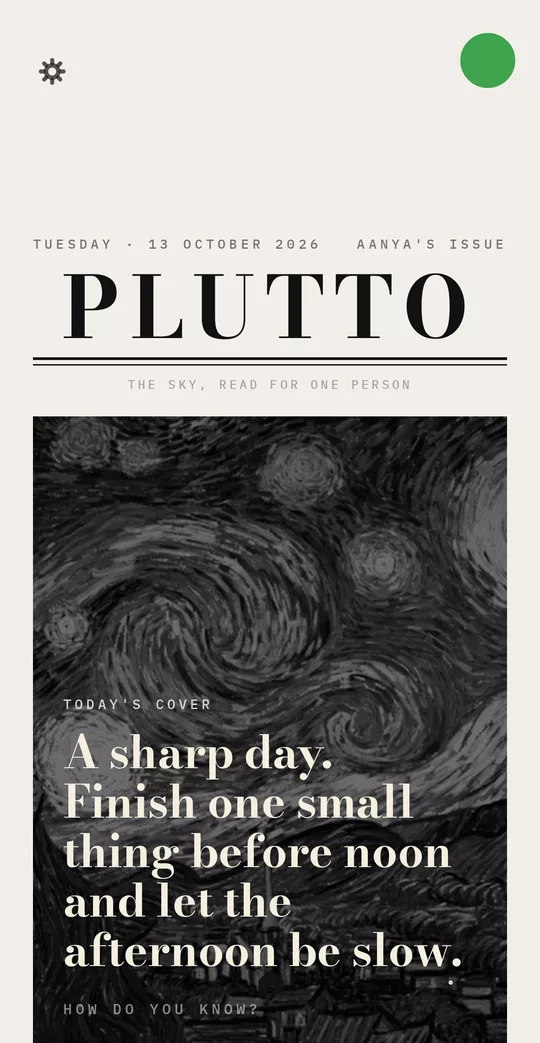
Today’s cover
Your day, set as an issue: one line written for you, and how it knows.
Open PluttoSources
- Cassius Dio, Roman History 37.18–19.
- F. H. Colson, The Week (Cambridge, 1926).
- Eviatar Zerubavel, The Seven Day Circle (1985).
Plutto presents these traditions for reflection; it does not claim that astrology predicts events.
Read next
The whole issue →The zodiac
The two zodiacs are 24° apart, and drifting further
The zodiac in a magazine horoscope and the one an Indian astrologer uses were once the same. The Earth’s slow wobble has pulled them apart, by about a day every seventy-two years.
2 min read

Ancient China
China’s oldest writing is a list of questions
Three thousand years ago, Shang kings asked about rain, the harvest, war, childbirth and toothache. The answers cracked across ox bones and turtle shells, and the questions were carved beside them.
2 min read
Ifá
Ifá reads 256 signs. A byte holds 256 values.
In Yoruba Ifá divination, each cast gives eight marks, each one single or double. Eight two-way marks make 256 possible signs: the same count as the eight bits of a computer byte.
2 min read