Ifá
Ifá reads 256 signs. A byte holds 256 values.
In Yoruba Ifá divination, each cast gives eight marks, each one single or double. Eight two-way marks make 256 possible signs: the same count as the eight bits of a computer byte.
The Plutto Magazine · 13 October 2026 · 2 min read
Ifá is the divination system of the Yoruba people of West Africa, now practised across Nigeria, Benin, Togo, Cuba, Brazil and beyond. In 2005 UNESCO proclaimed it a Masterpiece of the Oral and Intangible Heritage of Humanity.
Sixteen nuts, or a chain
A babaláwo, a priest of Ifá, either passes sixteen sacred palm nuts from hand to hand, or throws the opele, a chain of eight half seed-pods. Each pod lands open or closed. Each result is marked as one line or two, in two columns of four. That is eight marks, each one of two kinds: 2 × 2 × 2 × 2 × 2 × 2 × 2 × 2 = 256 possible figures, called odù.
Eight marks, each one of two kinds, make 256 signs.
Each odù is a library, not a single answer. It carries verses, ẹsẹ Ifá, that the priest learns by heart over years of training and recites to find the one that speaks to the question. The full corpus is enormous, and it is passed on almost entirely by memory.
Cousins across the Sahara
The sixteen four-mark figures also appear in Arabic sand divination, ʿilm al-raml, in European geomancy and in the Malagasy sikidy. Historians still argue about the direction of travel, but the family resemblance is plain. The mathematician Ron Eglash has traced how these binary figures reached Europe and connects them to the long road to binary arithmetic.
Sixteen cowries
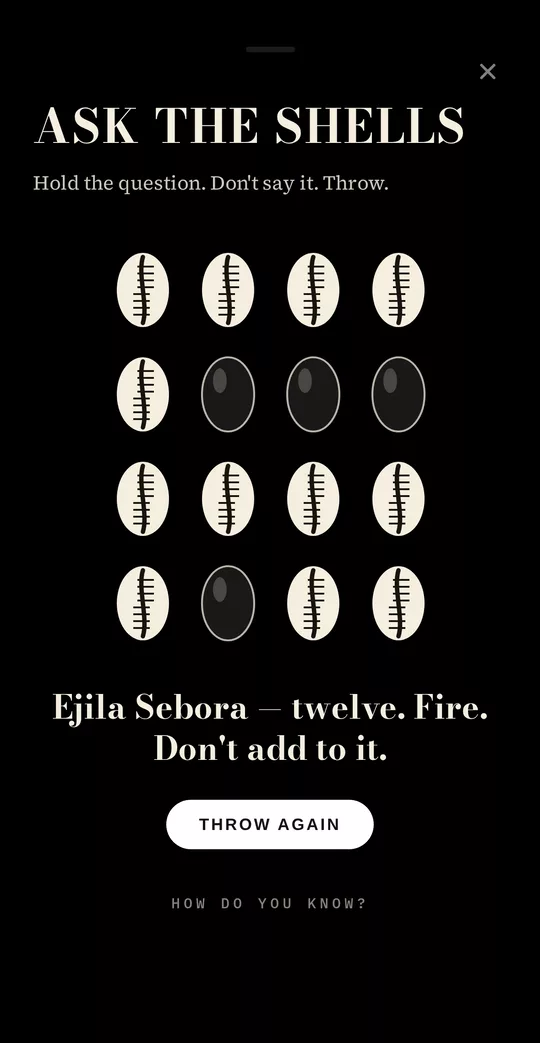
A related practice, ẹ̀rìndínlógún, throws sixteen cowrie shells and counts how many land mouth up. Each count has a name: five is Ọ̀ṣẹ́, eight is Èjì Ogbè, twelve is Èjìlá Ṣẹ̀bọ̀rà. Plutto’s shells follow those names.
In the app
Ask the shells
Hold a question. Throw. The answer follows the Yoruba names for each throw.
Open PluttoSources
- UNESCO, “Ifa divination system,” Representative List of the Intangible Cultural Heritage of Humanity (proclaimed 2005, inscribed 2008).
- William Bascom, Ifa Divination: Communication between Gods and Men in West Africa (1969).
- William Bascom, Sixteen Cowries: Yoruba Divination from Africa to the New World (1980).
- Ron Eglash, African Fractals: Modern Computing and Indigenous Design (1999).
Plutto presents these traditions for reflection; it does not claim that astrology predicts events.
Read next
The whole issue →
Language
Disaster, influenza, lunatic: the sky is hiding in your words
You speak astrology every day without noticing. A disaster is a bad star, influenza was an influence from above, and a lunatic was touched by the Moon.
2 min read

I Ching
The I Ching was already counting in binary
In 1701 a Jesuit in Beijing posted a diagram of the I Ching’s hexagrams to Germany. When Gottfried Leibniz read it, he found his own new arithmetic of nothing but 0s and 1s.
2 min read

Ancient Greece
A bronze computer, two thousand years old, that predicted eclipses
In 1901 sponge divers lifted a corroded lump of bronze from a shipwreck off the Greek island of Antikythera. Inside were gears, and on the gears, the sky.
2 min read