Stories the sky left behind
How a planetary clock named your week. Why the I Ching was already counting in binary. What Shang kings asked of ox bones about the rain. Short reads, every fact with its source.
Cover story
Cover story

I Ching
The I Ching was already counting in binary
In 1701 a Jesuit in Beijing posted a diagram of the I Ching’s hexagrams to Germany. When Gottfried Leibniz read it, he found his own new arithmetic of nothing but 0s and 1s.
2 min read
From the app
The magazine you carry
Plutto is set like this too: a new issue every day, written for one reader from their own sky. Tap a page to open it.
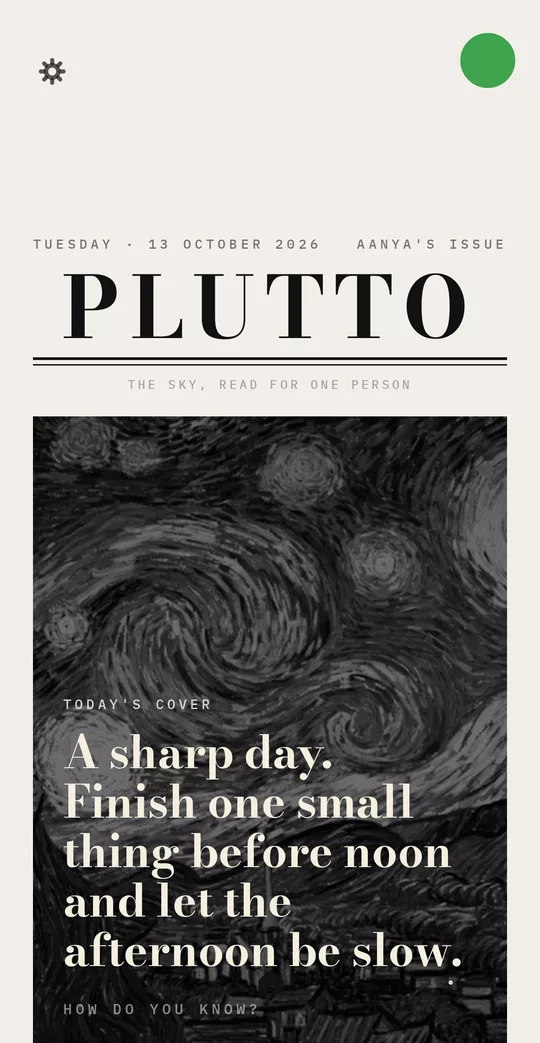
Today’s cover
Your day, set as an issue: one line written for you, and how it knows.
Open in the app →
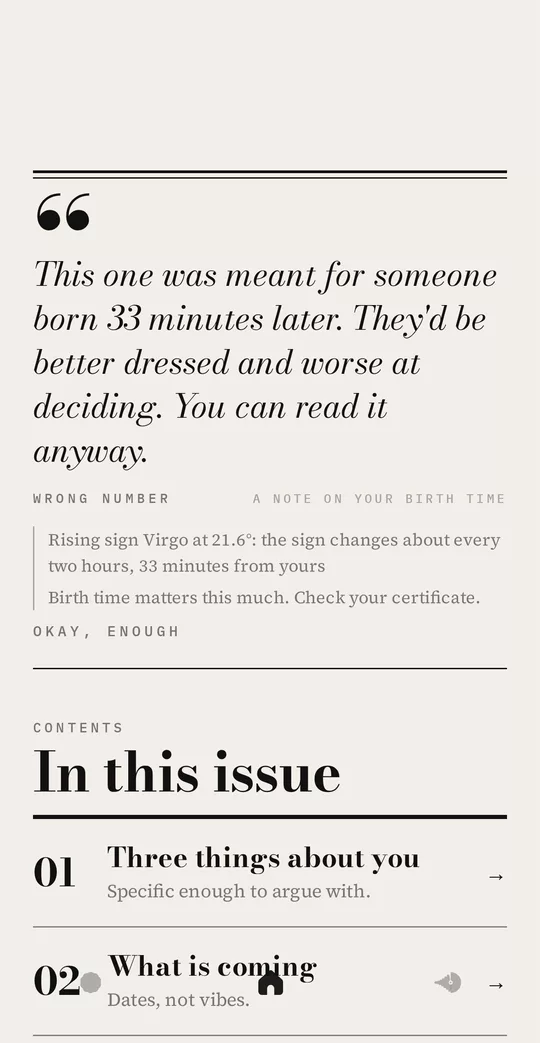
How do you know?
Every claim opens to its working: the method, the positions, and how much your birth time matters.
Open in the app →
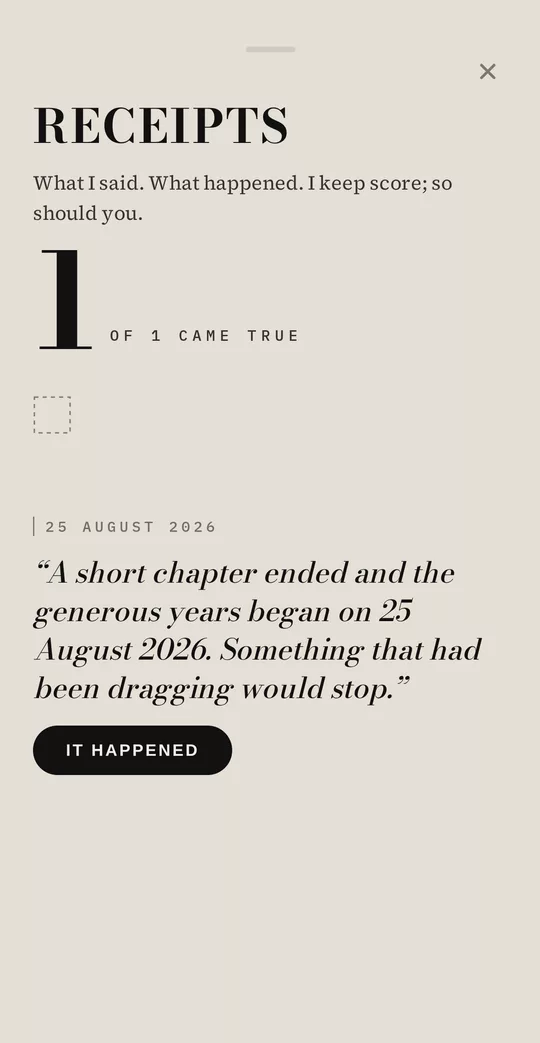
Receipts
What it said would happen, and whether it did. You mark each one.
Open in the app →
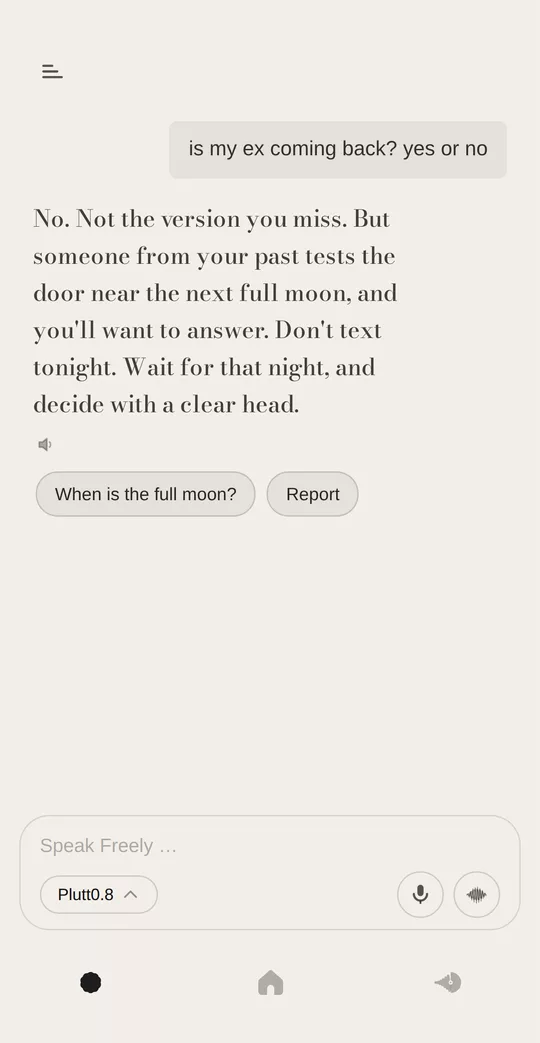
Ask
Ask anything, typed or out loud, in your own language.
Open in the app →
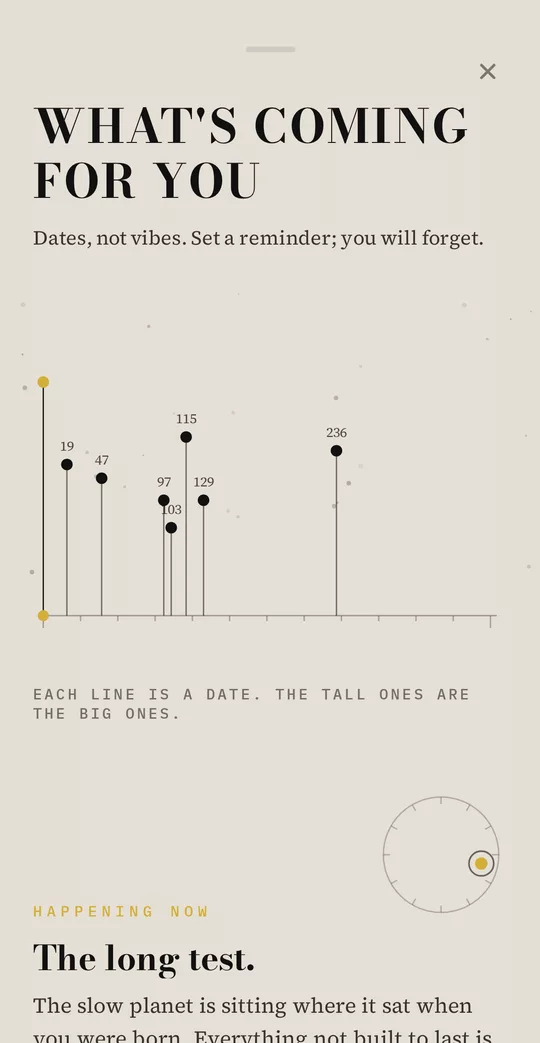
What is coming
The next two years on one line, drawn from your own sky, with a reminder for each date.
Open in the app →
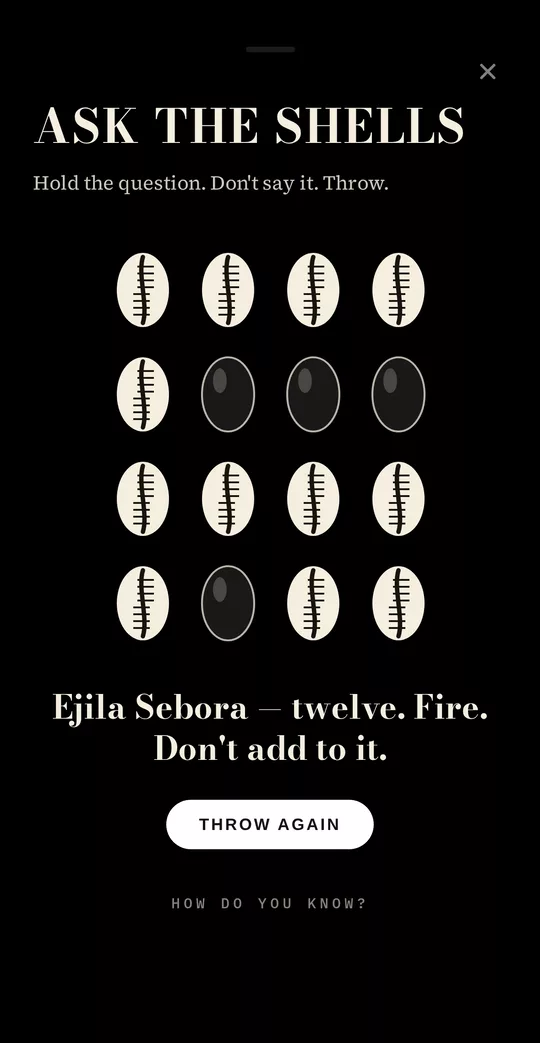
Ask the shells
Hold a question. Throw. The answer follows the Yoruba names for each throw.
Open in the app →
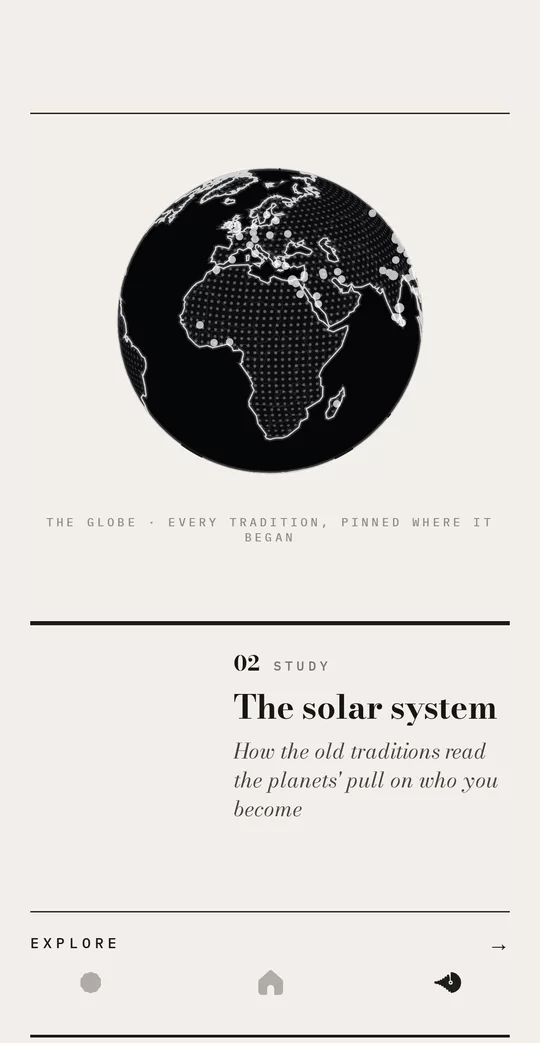
The atlas
The world’s divination traditions, each pinned where it began.
Open in the app →
In this issue


Ancient Greece
A bronze computer, two thousand years old, that predicted eclipses
In 1901 sponge divers lifted a corroded lump of bronze from a shipwreck off the Greek island of Antikythera. Inside were gears, and on the gears, the sky.
2 min read

Astronomy
The astronomer who cast horoscopes
Johannes Kepler found the laws of planetary motion that still steer spacecraft. He also drew up birth charts for a living, including two for the most feared general in Europe.
2 min read
The week
Why Monday follows Sunday: your week is a planetary clock
The days of the week are named for the seven lights the ancient world saw wandering across the sky. But their order isn’t the planets’ order. It falls out of a clock that gave every hour of the day to a planet.
2 min read
The zodiac
The two zodiacs are 24° apart, and drifting further
The zodiac in a magazine horoscope and the one an Indian astrologer uses were once the same. The Earth’s slow wobble has pulled them apart, by about a day every seventy-two years.
2 min read

Ancient China
China’s oldest writing is a list of questions
Three thousand years ago, Shang kings asked about rain, the harvest, war, childbirth and toothache. The answers cracked across ox bones and turtle shells, and the questions were carved beside them.
2 min read
Ifá
Ifá reads 256 signs. A byte holds 256 values.
In Yoruba Ifá divination, each cast gives eight marks, each one single or double. Eight two-way marks make 256 possible signs: the same count as the eight bits of a computer byte.
2 min read
From the margins
Worth knowing
Medieval physicians kept a “zodiac man” beside their books: a figure with each sign ruling a part of the body. The rule was never to bleed a part while the Moon stood in its sign.
Disaster, influenza, lunatic: the sky is hiding in your wordsSix lines with two states each give 2 × 2 × 2 × 2 × 2 × 2 = 64 hexagrams. Three lines give the eight trigrams. A computer’s bits work the same way.
The I Ching was already counting in binaryA saros is about 18 years, 11 days and 8 hours. The extra third of a day means each repeat of an eclipse happens about a third of the way further round the Earth.
A bronze computer, two thousand years old, that predicted eclipsesKepler’s Harmonices Mundi of 1619 announces his third law of planetary motion and, in the same book, discusses astrological aspects.
The astronomer who cast horoscopesDraw the seven planets on a circle in the old order and join every third one: the seven-pointed star you get traces the days of the week in sequence.
Why Monday follows Sunday: your week is a planetary clockThe pole star changes too. Polaris is near the pole today; in about 12,000 years the bright star Vega will be the nearest bright star to it.
The two zodiacs are 24° apart, and drifting furtherSome oracle bones record eclipses of the Moon. Astronomers have matched them to real eclipses to help date the Shang kings.
China’s oldest writing is a list of questionsA computer byte is eight bits, each 0 or 1, giving 256 values, from 0 to 255. Ifá arrived at the same number with seed-pods.
Ifá reads 256 signs. A byte holds 256 values.
The sky has been asked questions for as long as there has been writing. Ask it yours.
Plutto presents these traditions for reflection; it does not claim that astrology predicts events. Pictures are public domain or openly licensed, credited on each story.