Language
Disaster, influenza, lunatic: the sky is hiding in your words
You speak astrology every day without noticing. A disaster is a bad star, influenza was an influence from above, and a lunatic was touched by the Moon.
The Plutto Magazine · 13 October 2026 · 2 min read

English is full of fossils from a time when the sky was thought to steer life on the ground. Most of them are still in daily use, and almost nobody hears the stars in them any more.
A bad star
“Disaster” came into English in the late 1500s from the Italian disastro: dis-, a sense of something gone wrong, and astro, star. A disaster was an event under an ill-placed star. Shakespeare plays on it in King Lear, where Edmund mocks people who “make guilty of our disasters the sun, the moon, and the stars.” The same stage gave the world Romeo and Juliet, “a pair of star-cross’d lovers.”
A disaster was, literally, an event under an ill-placed star.
An influence from above
“Influenza” is the Italian word for influence, from the medieval Latin influentia, a flowing-in. Physicians described the power of the heavens as streaming down onto the earth, and epidemics that struck many people at once were put down to it. English borrowed the Italian name for the great epidemic of 1743, and the word for the illness stayed.
Moonstruck
“Lunatic” is the Latin lunaticus, moonstruck, from luna. Madness was long believed to wax and wane with the Moon’s phases, and English law used “lunatic” as a legal category well into the twentieth century.
Born under a planet
Temperament words come from the same source. Someone “jovial” was born under Jupiter (Jove) and expected to be good-humoured; someone “saturnine” under slow, cold Saturn; someone “mercurial” under quick, changeable Mercury; and “martial” things belong to Mars. “Ill-starred” and “thank your lucky stars” say the rest plainly.
Two more are often listed and are less certain. “Consider” comes from the Latin considerare, which some scholars read as “to examine the stars” (sidus, star); others disagree. “Desire,” from desiderare, has a similar disputed story. Either way, the habit of looking up before deciding left its mark on how we talk about deciding.
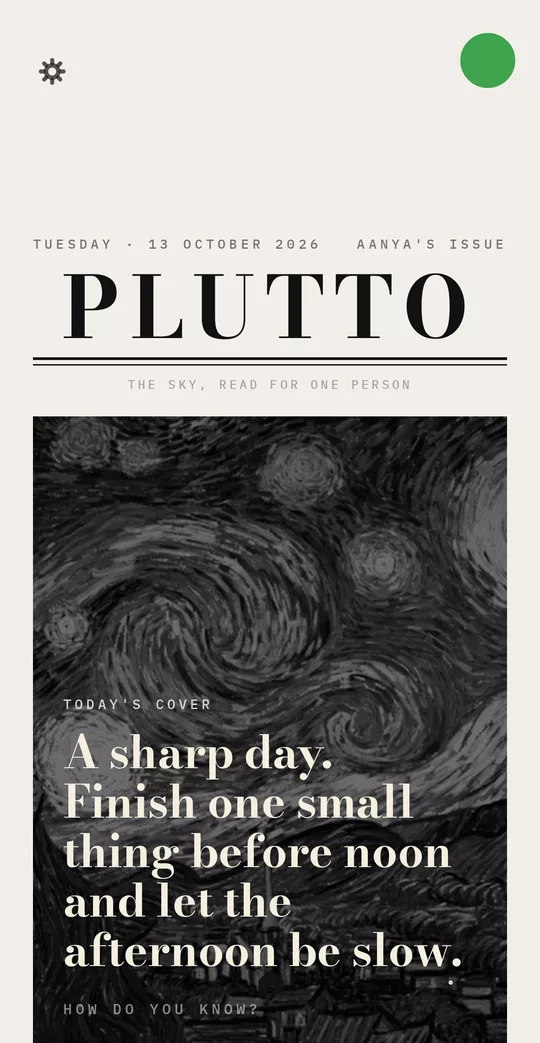
In the app
Today’s cover
Your day, set as an issue: one line written for you, and how it knows.
Open PluttoSources
- Oxford English Dictionary, entries “disaster,” “influenza,” “lunatic,” “jovial,” “saturnine,” “mercurial.”
- Online Etymology Dictionary (etymonline.com), the same entries and “consider,” “desire.”
- William Shakespeare, King Lear, 1.2, and Romeo and Juliet, Prologue.
- Les Très Riches Heures du duc de Berry, Musée Condé, Chantilly, Ms. 65, f. 14v.
Plutto presents these traditions for reflection; it does not claim that astrology predicts events.
Read next
The whole issue →
I Ching
The I Ching was already counting in binary
In 1701 a Jesuit in Beijing posted a diagram of the I Ching’s hexagrams to Germany. When Gottfried Leibniz read it, he found his own new arithmetic of nothing but 0s and 1s.
2 min read

Ancient Greece
A bronze computer, two thousand years old, that predicted eclipses
In 1901 sponge divers lifted a corroded lump of bronze from a shipwreck off the Greek island of Antikythera. Inside were gears, and on the gears, the sky.
2 min read

Astronomy
The astronomer who cast horoscopes
Johannes Kepler found the laws of planetary motion that still steer spacecraft. He also drew up birth charts for a living, including two for the most feared general in Europe.
2 min read